
Why Choose Us?
Rich Experience
Wenzhou Zhongtou Valve/ZT Valve has been engaged in the stainless steel industry for more than 30 years and has been exporting stainless steel products for more than 15 years. With persistence and effort, we have become one of the leading enterprises of valves fittings and flanges in China.
Professional Team
ZHONGTOU VALVE has a technical team with rich experiences in fluid control system, and we own industry-leading installation and inspection equipments. From drawing to installation, ZHONGTOU VALVE will provide you with the most professional services, technical assistance and quality assurance, to optimize your system operation in the best state.
Overseas Markets
ZHONGTOU VALVE has its own foreign trade sales department. It has been established for more than 20 years and has been exported to more than 30 countries, such as European countries, Spain, the United Kingdom, the United States, Iran and Vietnam, Malaysia, Singapore and other countries.
Wide Range of Products
Our products include ball valve, gate valve, globe valve, check valve, butterfly valve, needle valve, strainer, flange, thread pipe fitting, butt weld pipe fitting, sanitary pipe fitting, sanitry valve, forged high pressure valve, forged high pressure pipe fitting.
What Is Sanitary Butterfly Valve
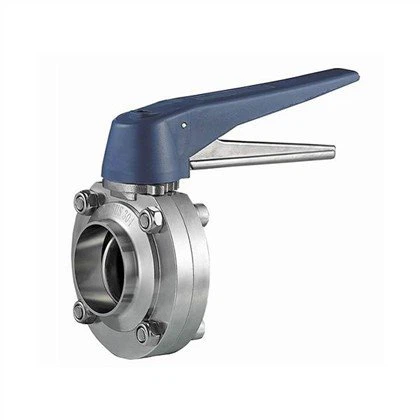
Sanitary butterfly valves consist of a circular disc that rotates within the valve body, controlling the flow of fluid through the pipe. They are often used in large-diameter piping systems where cost and weight are a concern.
-

3A Butterfly Valve
The characteristic of sanitary butterfly valve is that the surface is bright so it does not stick to dust. The sanitary butterfly valve body is detachably connected, simple structure and easy Add to Inquiry -
Din Butterfly Valve
Product Name: Stainless Steel Food Grade Sanitary Hygienic Butterfly Valve. Valve Body Material: 1.4404/1.4301, SS304/SS316L(Forged). Max Working Pressure: 10Bar(DN25 to DN100), 8 bar(DN125 to Add to Inquiry -
Sms Butterfly Valve
Max Working Pressure: 10Bar(DN25 to DN100), 8 bar(DN125 to DN150), 5 bar(DN200 to DN300). Surface Finishing: RA<0.8 um. Surface: CNC machine. Standard: DIN/SMS/RJT/ISO/IDF Add to Inquiry -
Sanitary Butterfly Valve
The opening and closing range is 0~90 degrees, which can be fixed at 15 degrees interval, with adjustable, and it opens and closes quickly and is easy to operate. Add to Inquiry -
Butterfly Valve with Gripper Handle
Product Name: Stainless Steel Food Grade Sanitary Hygienic Butterfly Valve. Valve Body Material: 1.4404/1.4301, SS304/SS316L(Forged). Max Working Pressure: 10Bar(DN25 to DN100), 8 bar(DN125 to Add to Inquiry



Advantages of Sanitary Butterfly Valves
Cost-effective
Generally more economical than other types of valves.
Compact design
Requires less space, simple mechanism, and lighter weight compared to other valve types.
Quick operation
Offers rapid on/off functionality, enhancing process efficiency.
Minimal maintenance
Simple construction reduces maintenance needs and costs.
Versatility
Compatible with a wide range of fluids and applications.
High capability
Capable of handling high fluid flows with suspended materials at comparatively low pressures.
3 Main Sanitary Butterfly Valve Types
Zero-offset sanitary butterfly valve
"Concentric" or "rubber seated" are other names for the zero-offset design. Zero-offset means there is no offset by the stem of the valve. The valve seals via interference along the disc edge at the stem between the disc and the rubber seat.
The rubber seated valve has the lowest pressure rating (up to 250 PSI) and withstands heat up to 400°F. Its rubber seat encases the body to prevent contact with the material which maintains the purity of the media.
High-performance double offset sanitary butterfly valve
This sanitary butterfly valve is referred to as a double offset because the offset is in two places: At the line of the disc seat /body seal, and at the bore. Off-center positioning increases durability for the seal. High-performance valves tolerate pressure up to 1440 PSI and temps up to 1200°F.
A cam-action occurs from the stem being behind the disc as it rubs against the during rotation at 90° for the first 10 degrees of opening, but also for the 10 degrees of closing.
Triple offset sanitary butterfly valve
The best type of sanitary butterfly valve for high-pressure systems is the triple offset sanitary butterfly valve. Of the three types, the triple offset is the most advanced with lower emissions and is designed to work with various environments. Its heat tolerance is 1200°F as it can withstand 1,480 psi of pressure.
Like the double offset valve, the triple offset valve consists of two offsets situated in the center, but with a third offset having cam action with right-angled conical sealing. It is frictionless and long-wearing by the metal seal components not making contact until their final point.
Four Main Parts of the Sanitary Butterfly Valve
Sanitary butterfly valves are a quarter-turn rotational motion valve that can start, stop, and regulate flow. They are simple to use, which makes them a popular choice. Below are the parts of a sanitary butterfly valve and how they contribute to the function of the valve.
Body
The body of the sanitary butterfly valve is the part that fits between the two pipes. This slim valve comes in two major body styles: Wafer and lug. The wafer style body is the most economical of the two. It is connected to the pipes with bolt holes that run through the body of the valve. This design is easy to install and primarily used to prevent backflow in universal flow systems.
Lug sanitary butterfly valves are connected to the pipe through protruding lug holes on the outside of the body of the valve. With this design, the valve actually helps carry the weight of the piping throughout its body, unlike the wafer valve. This allows for removing piping from one side of the valve for dead-end servicing.
Disk
Both wafer and lug style sanitary butterfly valves have a disk inside, and this disk is what controls the flow of media through the valve, much like a gate in a gate valve or the ball in a ball valve.
The disc of the valve can be either concentric or eccentric. The simplest of these two is the concentric disk. In the concentric design the stem passes through the centerline of the disk. Concentric valves are commonly used in low pressure applications.
The eccentric disk design, however, has a stem that doesn't pass through the center line, but rather behind it, in the opposite direction of the flow. The eccentric disk was first designed to help prevent contact of the disk and seal before it was fully closed to help prolong and improve life of the valve.
Stem
The stem of the sanitary butterfly valve may seem like a small part, but it plays an important role. The stem is what connects the disk inside to the handle outside.
The stem has two different designs—wetted or non-wetted—which refers to the protection on the stem. Non-wetted stems are protected against any potential corrosive or erosive media in the line. Wetted stems are not protected against these and, thus, must be made of material that is compatible to the media flowing through the line.
Seat
The seat of a sanitary butterfly valve is made of different elastomers or polymers and is either bonded to the body or pressed or locked down. The seat runs along the inner diameter of the valve. When the disk presses along the seat, they seal together to stop the flow. When sanitary butterfly valves were first designed the metal of the disk sat against the metal body, which did not provide a tight, leak-free seal. The addition of elastomers or polymers to the design of the valve is what helps provide the leak-proof seal.

How to Determine if Your Sanitary Butterfly Valve Is Open
Sanitary butterfly valves differ from all the other valves not only can they be used as a shut-off valve, they can also be used as a regulatory valve. Inside the sanitary butterfly valve is a disc that rotates as you turn the handle. Sanitary butterfly valves can regulate flow by having the disc partway open.
Sanitary butterfly valves have a lever handle on the top that is similar to the ball valve. This handle both indicates if the flow is on or off, and can be used to turn the valve partway on by locking the disc in place. When the handle is parallel to the valve, it is closed, and when it is perpendicular to the valve, it is open.
Sanitary butterfly valves are suited for use in garden irrigation, and they are also commonly used in space-restrictive applications. They have a slender design that makes them ideal for tight-fitting spaces. Because of the disc inside, these valves are not the best to use in high-pressure applications as there will always be something in the way partially blocking the flow.
How Do You Set a Sanitary Butterfly Valve
Pre-Installation & Inspection Guidelines
Thoroughly inspect the valve, ensuring that the waterway is free from any debris or foreign particles. Additionally, ensure that the adjacent pipeline is clean to prevent potential damage to the seat and disc sealing surfaces.
Prior to installation, attach the actuator to the valve. This will aid in achieving accurate alignment of the disc within the valve seat.
Examine the valve's identification tag, verifying the materials used and the specified operating pressure. Confirm that these details are suitable for the intended application.
Verify the dimensions, threading, and length of the flange bolts or studs to ensure compliance with the required specifications. Verify the dimensions, threading, and length of the flange bolts or studs to ensure compliance with the required specifications.
Installation Procedure
Align the connecting pipe flanges accurately before installing the valve. Create enough separation between the pipe flanges to allow the valve body to be situated between them without making contact with the flange surfaces. Handle the valve with care to avoid potential damage to the disc or seat faces.
For Lug style valves:
Position the valve between the flanges.
Mount all necessary bolts between the valve and the mating flanges. Hand-tighten the bolts, but not all the way.
Prior to fully tightening the bolts, ensure the valve is centered between the flanges, then open and close the valve carefully to confirm free and unobstructed disc movement.
Tighten the flange bolts uniformly, adhering to the sequence illustrated, to achieve consistent compression.
Open the valve to the maximum open position and then back to the fully closed position, examining the actuator travel stop settings for correct disc alignment. It is crucial that the valve operates without any interference.
The valve is now ready for operation.
● Note: Install the valve with the disc in the "ALMOST CLOSED" state. The use of flange gaskets is not advised.
How Do Sanitary Butterfly Valves Work as Throttling Devices
Sanitary butterfly valves work as throttling devices by controlling the flow of fluids through a circular disc or plate positioned in the path of the flow. The disc is mounted on a shaft that is rotated by a handle or actuator, allowing the disc to be positioned at different angles to the flow path.
When the disc is in a fully open position, the fluid flows through the valve with minimal resistance. However, when the disc is partially closed, the fluid encounters a smaller opening, creating a more significant pressure drop and reducing the flow rate.
Sanitary butterfly valves are only effective for throttling when properly designed and selected for the specific application. Not all sanitary butterfly valve designs are created equal, so it's important to consider the available options to ensure optimal performance.
The commonly used zero offset sanitary butterfly valve is not well-suited for throttling, as it can lead to significant flow restrictions and pressure drops, especially at high flow rates.
On the other hand, double eccentric sanitary butterfly valves, offer much better flow regulation thanks to their unique build. With a reduced risk of seat set or deformation and a design that prevents valve rubbing on the resilient seat until the last 10% of closure, it's an ideal choice for throttling applications.
Something to always be aware of, is that when using a sanitary butterfly valve for throttling, the chances of cavitation increase due to the design of the valve. When high pressure and velocities pass through the valve to the other side of the disc, we run into the possibility of cavitation and this should be considered when selecting the correct valve for your application.

Our Factory
WENZHOU ZHONGTOU VALVE/ZT VALVE is located in Wenzhou City, Zhejiang Province, a place with a very developed stainless steel industry. There is a well-established and mature supply chain here. Our founders have been in the stainless steel industry for over 30 years and have been exporting stainless steel products for over 15 years. We mainly export to over 30 countries in North America, South America, Europe, Asia and other states. With persistence and effort, we have become one of the leading enterprises of valves fittings and flanges in China.
Because of the trust of our customers we have developed more and more, and we also hold a foundry, all for better quality control.


FAQ
As one of the leading sanitary butterfly valve manufacturers and suppliers in China, we warmly welcome you to buy discount sanitary butterfly valve from our factory. All our products are with high quality and competitive price. Contact us for quotation.
ball valve for petrochemical, bronze butterfly valves, ball valve with ball